FAQ: Your Comprehensive Guide to Minibus Terminology for 2026
Entering the new year, EVM UK & Ireland wanted to provide a complete list of minibus terminology to help you, whether you are new to the world of minibuses or returning to expand your fleet.
Types of Minibus:
Minibus – A passenger vehicle, typically carrying up to 30 passengers, which is smaller than a bus but allows for transport of large groups.
Accessible Minibus – A minibus designed with community and ease of access in mind. EVMs Accessible minibuses aim to provide flexible, easy to use travel solutions for any level of mobility, often including lifts, ramps, durable materials and floor tracking systems.
Wheelchair Accessible Vehicle (WAV) – A vehicle specifically adapted to carry wheelchair passengers safely. All EVM Accessible Minibuses are WAV or WAV adaptable.
EV / Electric Minibus – A minibus reliant on battery power rather than diesel. These zero-emission transport solutions are ideal for urban environments and are great investments within ULEZ/LEZ zones.
Luxury Minibus – A minibus aimed for premium markets and private hire. These minibuses come with a host of passenger focused, ensuring they travel in style, comfort and class.
School Minibus – A minibus ideal for everyday transport routes. Whether that be due to low floor capabilities or seating configurations, EVMs School Minibus Range provides a collection of the most functional.
Midi Coach – A passenger vehicle that bridges the gap between a minibus and a coach, designed for more capacity than a typical minibus whilst remaining more manoeuvrable than a coach.
Minibus Conversion – The process of modifying a standard, reliable panel van into a passenger carrying vehicle. EVM stocks a variety of minibus conversions, most commonly Mercedes-Benz Sprinter and Iveco Daily conversions. By adding seats, improving interior comfort, and adding safety features, commercial vehicles become excellent quality minibuses.
Coach Built Minibus – The process of taking a chassis cab and mounting a purpose-built passenger vehicle body. This can provide a different aesthetic and more luggage room than a minibus conversion. EVMs Grand Tourer and Ferqui Range is an example of a coach built minibuses.
Ground Built Minibus – Rather than building from a commercial van, ground built refers to minibuses and coaches that are engineered specifically as a what their end product is.
Chassis/ Base Vehicle – The foundation of any vehicle, described as the base frame of a wheeled vehicle.
Tachograph – The Tachograph is a device that records information like driving time, speed and distance. This insures drivers and employers are following the rules about Drivers Hours. All EVM vehicles come pre-fitted with a Tachograph.
Guide Seat – An additional passenger seat, typically foldable and unobstructive, which allows for crew/ a guide to be seated near the driver, without taking a seat from passengers.
Regulations:
GSR2(General Safety Regulation 2) – An EU law which mandates advanced driver assistance systems in new vehicles to improve road safety.
PSVAR(Public Service Vehicles Accessibility Regulations) – UK laws that require buses and coaches to be accessible for disabled passengers, aiming to provide equal access with features like wheelchair accessibility and clear audio/visual information. On vehicles with over 22 seats used for local or scheduled services, PSVAR mandates features like lifts, ramps, and priority seating.
PSVAIR (Public Service Vehicle Accessibility Information Regulations) – Building on PSVAR, PSVAIR focuses on ensuring every passenger using local transport services has access to high-quality on-board information at all times. PSVAIR refers to technology like audible systems, visual displays and hearing loops. To learn more about the differences between PSVAIR and PSVAR, click here to read our article here >>>
PSV – A minibus or coach used to carry fare-paying or contracted passengers.
PSVAIR Prep – An industry term, meaning a minibus or midi coach is wired and set up so SVAIR equipment can easily be installed.
GB type-approval category – Vehicles are classified based on their passenger capacity and weight which is used for safety regulations like GSR2 or licensing:
M1 – up to 8 passenger seats
M2 – more than 8 passenger seats, up to 5 tonnes
M3 – more than 8 passenger seats, over 5 tonnes
Grandfather rights – Drivers who passed their car test before 1 January 1997 may have “grandfather rights” giving them D1 entitlement automatically. This can be checked on the back of a license.
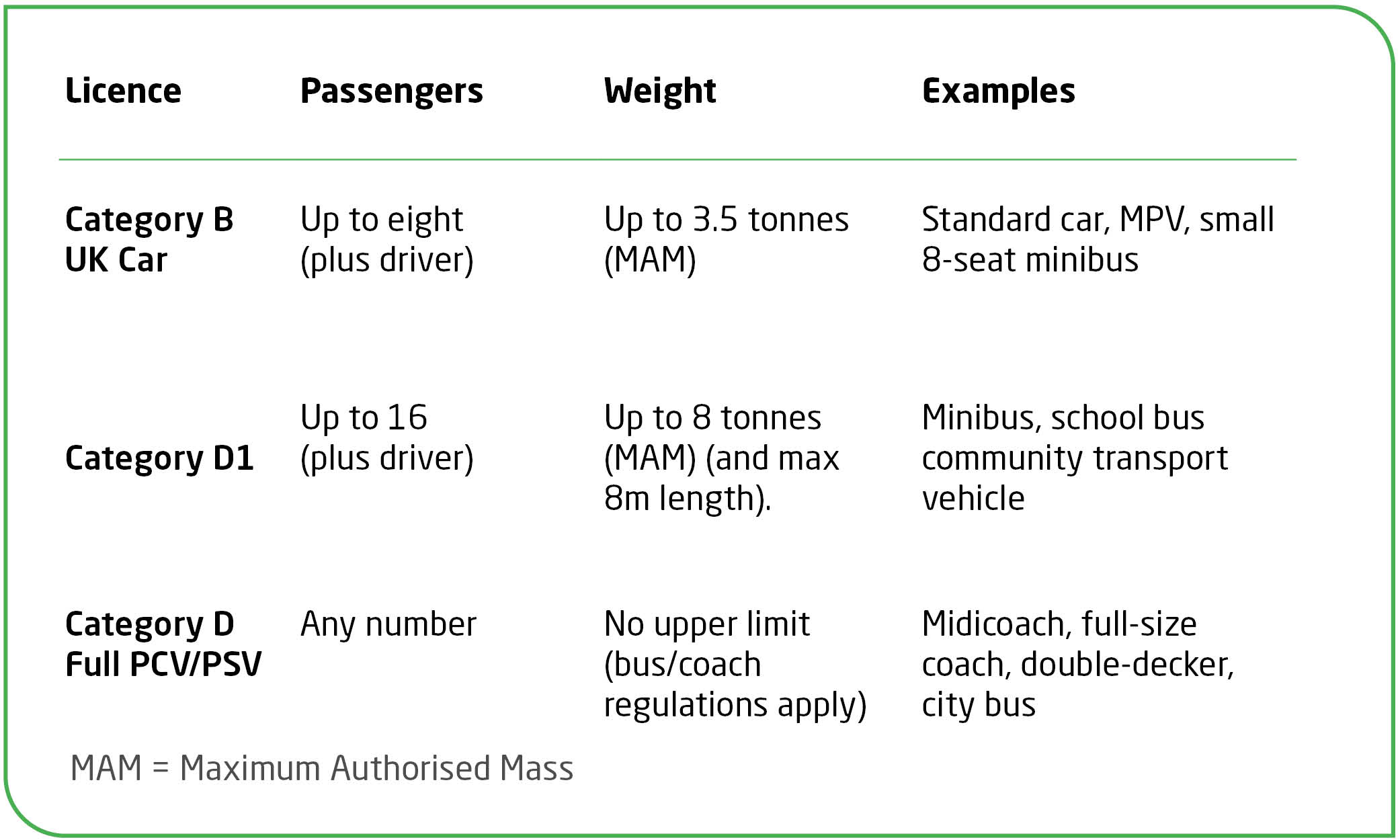
Licenses – Depending on the amount of passengers and weight of vehicle you are looking at, depends on which license you may require. Click here to read our full article >>>
Safety Acronyms:
ADAS (Advanced Driver Assistance Systems) – The technology in vehicles that use sensors, cameras, and radar to help increase safety when driving by providing alerts or taking automated actions.
MAM (Maximum Authorised Mass) or GVW (Gross Vehicle Weight) – Total weight a vehicle can hold which must not be exceeded for safe and legal operation of the vehicle.
BSIS (Blind Spot Information System) or BSM (Blind Spot Monitoring) – Detects vehicles in blind spots and alerts the driver to help prevent collisions.
MOIS (Moving Off Information System) – Detects pedestrians around the vehicle when pulling away and alerts the driver.
ISA (Intelligent Speed Assistance) – Supports compliance with speed limits and alerts the driver when speeding.
ESS (Emergency Stop Signal) – Automatically activates hazard lights during sudden braking to warn following vehicles.
CYBSC (Cybersecurity) – Protects in-vehicle communication systems against cyber threats and ensures secure data transmission.
RM (Reversing Motion) – Alerts the driver to obstacles when reversing.
ACC (Adaptive Cruise Control) – Maintains a set speed and will adjust to maintain a safe distance from the car ahead.
AEB (Automatic Emergency Braking) – Senses and automatically activates brakes if a potential collision is detected.
LKA (Lane Keeping Assist) or LDW (Lane Departure Warning) – Steers or alerts to the vehicle drifting out of lane/ over the central white line.
ASR (Anti-Slip Regulation/Traction Control) – Prevents wheelspin during acceleration.
EBS (Electronic Braking System) – A control platform which integrates ABS, ASR, and stability functions together offering better control
ESC (Electronic Stability Control) – Technology that prevents skidding and loss of traction.
DRL (Daytime Running Lights) – Mandated in all new vehicles since 2011, these are automatic, low-wattage lights that improve visibility during the day for other road users.
TPMS (Tyre Pressure Monitoring System) – A feature in vehicles that monitors air pressure inside tires. If pressure drops too much, the system alerts the driver via a dashboard light.